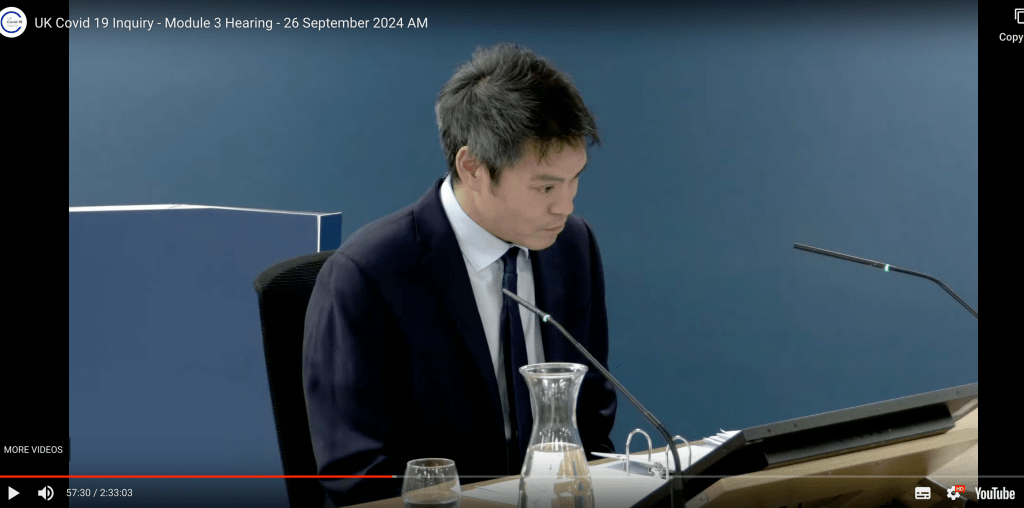
Last week Professor Kevin Fong, during evidence given to the UK Covid Inquiry, articulated with such eloquence and devastating impact. If you are accountable for a team, or in a senior leadership or governance position in any organisation then this short extract should be mandatory viewing.
It is teed up to start at 57:28 and watch through to the 1:00:13 when the lawyer asks a question.
The Peer Support Programme
During the Covid Pandemic, Professor Kevin Fong, was responsible for organising and leading a programme of peer support visits for intensive care units across England. In September he gave evidence to the Covid Inquiry.
I want to highlight three points that he made which bear great relevance to any organisation and very much to post-Grenfell change.
Measurement and Insight
Complex Socio-Technical Systems
Support and Care
Measurement and insight
There is more to know that what you can count’.
Fong shares with devastating impact what he calls the data information gap between information and insights. Highlighting the limitations of our more traditional ways of measuring and ‘knowing’ what is happening in organisations, he states that one of the reasons he had established the peer support visits was to close this gap between data information and insights, so that you could give the emergency preparedness resilience and response team an accurate picture of what staff were dealing with.
Speaking to how we undervalue anecdotal data and can dismiss it against traditional ‘hard data’, he says (edited for ease of reading):
There is understandably this value that we attribute to stuff that you can count. But, not everything that counts can be counted. And for me, if we were talking about the capacity available in these units, then we had to understand this anecdotal picture. This picture is a complex assessment of a complex system, and that’s why I was taking the teams in.
The doctors and nurses who came with me are system experts. They are able to see with their own eyes and have an assessment of what is happening
It absolutely confirms my belief that the data.. the information are important but the insight is gained by going and seeing these people and having a group of people who understand what it is… it is easy for us to think that we knew what was going on.
He concludes this piece of his evidence by an almost throwaway line, pointing to the inadequacy of much of the data and information used by those in senior positions to inform decisions.
What you can measure most easily that is seen at the top.
Complex Socio-Technical Systems
There is in the system a human element and a technical element, and we get good at managing technical elements, but the social element that we depend upon to close the gap between reality and expectation in a system that every single day wants to tear itself apart, and during Covid much more so, we do not pay enough attention to.
Fong speaks very eloquently to complex socio-technical systems and the failure to pay sufficient attention to the human elements. As he says:
So much of this pandemic was about the concept of capacity and the capacity of the healthcare system. So much hinged upon that. But healthcare — capacity in healthcare systems is a complex feature of a complex system. It requires a complex assessment.
There is a tendency also to eschew this kind of anecdotal data, as the lowest form of information. Fong says in the case of the programme he ran this was not the case.
Whilst not so acute, or comparable to the horrors of those at the front-line of COVID, in the built environment we are dealing with the capacity of the system to deliver, manage and maintain safe homes for people. And I think this failure to understand capacity (or competence or culture) as complex features of a complex system, means we are perhaps not paying enough attention to the social elements, to the humans living in homes, or delivering services, or constructing tower blocks. For relying too heavily on traditional data or ‘insights’ reports and ‘engagement’ surveys, rather than this anecdotal and deeply nuanced and personal insight gained through the this extraordinary peer support programme.
As Fong says:
You need to have a mechanism that stops information having to flow through all the filters in between, so that the decisions that are made at the top — there is a way of the people at the front line to signal their experience without it being diluted.
It is easy for us to think that we knew what was going on. And this isn’t just a problem with the NHS. Any large organisation suffers this problem, any multilayered organisation suffers this problem, of what you can measure most easily, that’s seen at the top, between what is actually happening at the front line.
And I think that it was easy to convince ourselves that we knew what was happening, but you don’t know.
You don’t know unless you’re the people going into that shop floor.
You don’t know if you’re not the people who are putting on PPE before you’ve got vaccinations available, wondering if it’s buttoned up okay.
You don’t know unless you’re the people who have run out of body bags and put people in plastic sacks.
You don’t know if you’re not the people who held onto iPads while relatives are screaming down the phone.
You don’t know if you haven’t sat in transfer vehicles next to a patient who is dying of Covid wondering if your PPE is buttoned up well enough that you might not do the same.
It is impossible to know.
Support and Care
The human resource, the people that stop it all from falling apart from day to day, we didn’t really have sufficient mechanisms to measure and monitor that or indeed protect them.
The peer support programme was set up to support those at the front line of dealing with Covid. When asked about the lessons going forward Fong says:
We all had the same conclusions. The first was: we were always surprised at just how supported the staff felt by this. The sense they weren’t alone. The sense they weren’t getting it wrong, that it wasn’t their fault, and that other people elsewhere in the country were experiencing similar or the same. The ability just to talk with people who were going through the same thing was incredibly supportive. Many of them said it was the first time they realised that they weren’t on their own. And I think it did change the way that we saw these people. And the most important thing is the need to support their wellbeing.
Provocation
I wonder what would happen in the built environment if we began listening in this way, if we began valueing and collecting anecdotal evidence in a peer review process. What would happen if we listened
to staff in social housing delivering services, or
to those caught up in the building safety crisis whose lives are reduced to technical data such as the ‘% of cladding removed’, or
to those large and small organisations who are struggling (and failing) to deliver the change that is so needed in a post-Grenfell context?
I wonder too
How much our failure to change at the pace needed post-Grenfell is a failure to understand what we are facing as complex feature of complex socio-technical systems?
How much we understand REALLY what those at the front line of delivering change are experiencing or how those living in unsafe home with little agency to change things are impacted?
What would we hear, what new solutions and approaches would we adopt if we became as interested in the social and human elements as the technical?
And what would happen if we focussed on support and care?
How much of our attention is on support and care for housing staff, for residents, for construction workers, for workers and executives and politicians and civil servants and small business owners bearing the burden of change, how much are we focussed on support and care?
I wonder what would happen if we understood the human element not just the technical. If we moved beyond blame and finger pointed what new ways of approaching change would we discover?
As Prof. Fong says:
It is about wellbeing. Again, it is that point about –and I repeat it deliberately because it’s so important but I think so overlooked. We managed the technical aspect of this complex system, we do not look after the social aspect. We go in and we check our machines andour drugs every day to make sure that they are there when we need them in a difficult moment. No one really does that for our staff. We do not have the right mechanisms to measure and monitor, protect and promote the wellbeing of the human workforce upon whom everything depends, whether you are in a pandemic or not.
I am left pondering deeply about how these insights can be applied in the built environment to drive post-Grenfell change.

 The Grenfell Enquirer
Join the enquiry…